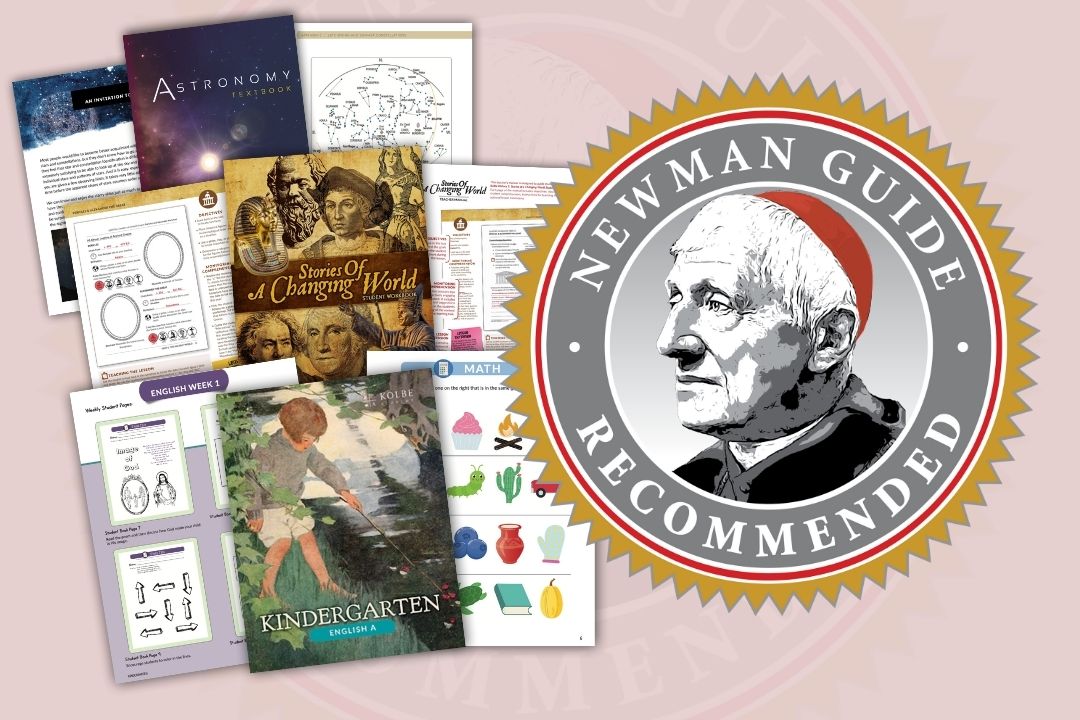
Kolbe Academy provides a faithfully Catholic, classical curriculum for homeschool families and schools. Our curriculum integrates the Catholic faith across every subject and is designed to form students in truth, wisdom, and virtue. As a Newman Guide Recommended Curriculum Provider, Kolbe Academy affirms full fidelity to the Magisterium of the Catholic Church, giving parents confidence that their children’s education is fully aligned with Catholic teaching.
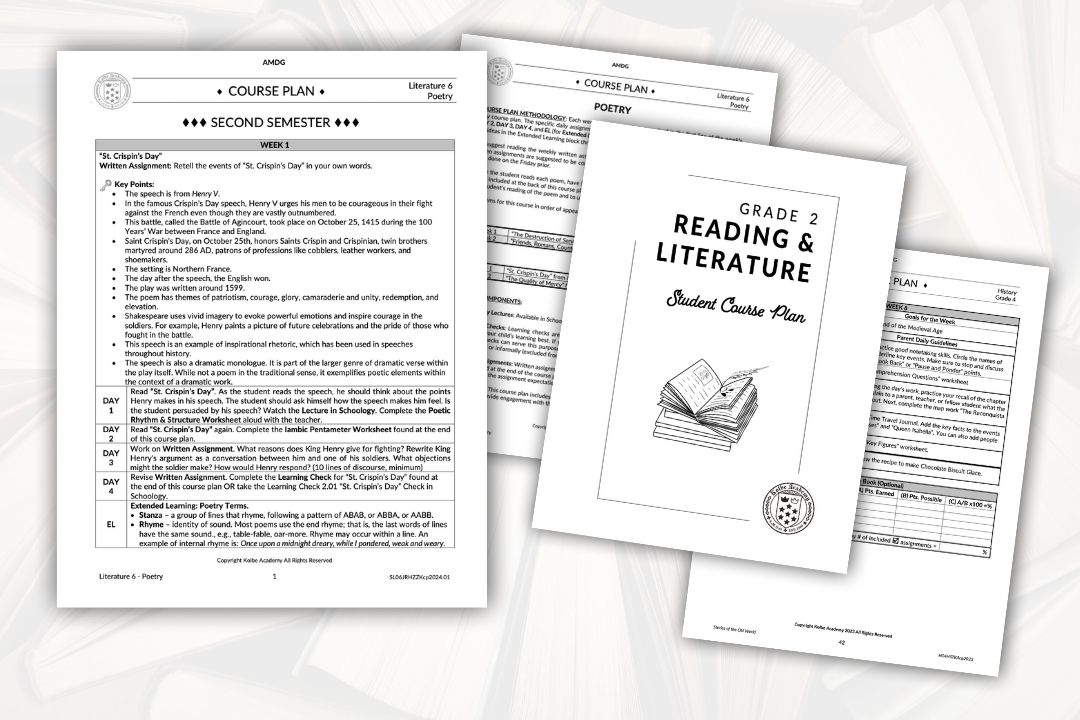
Kolbe Academy’s course plans offer complete programs for PK–K and a robust catalog of 1–12 courses that can also be used individually. They provide families with clear guidance and pacing while allowing them to follow the curriculum map’s progression or customize learning to each student’s needs.
Course plans include:

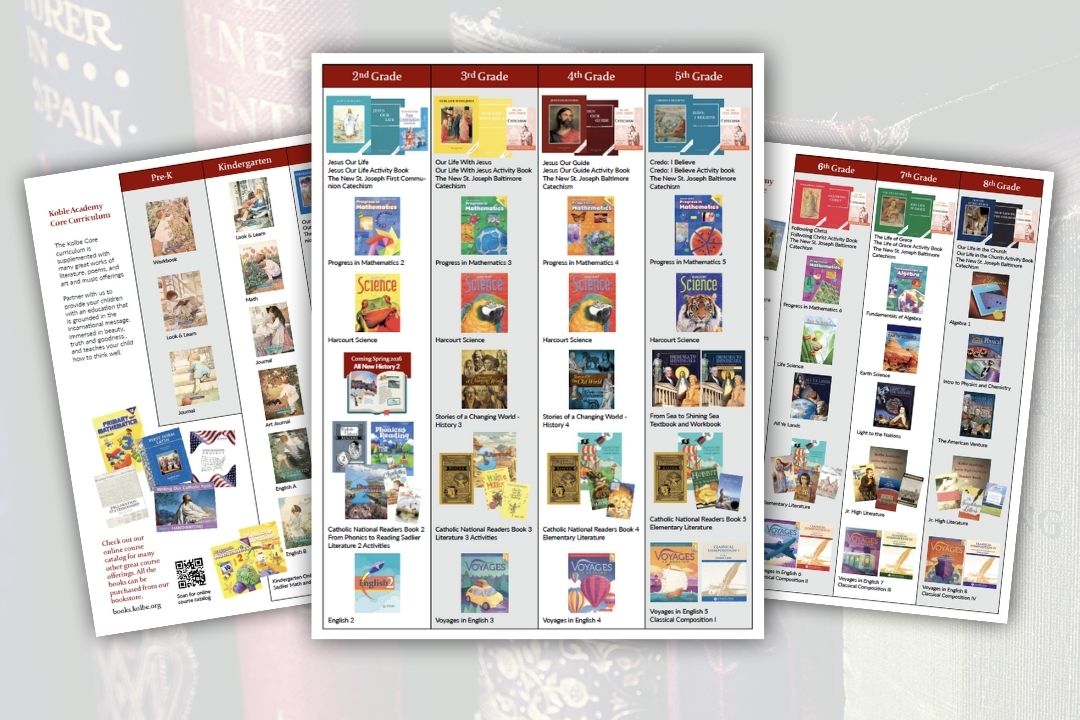
Kolbe Academy develops original courses grounded in the classical tradition, ensuring academic rigor and full fidelity to Catholic teaching. Our curriculum map illustrates the progression of learning across grade levels through the core curriculum, serving as a helpful guide for families. Beyond the core map, families can tailor pacing, select additional courses, and customize learning to create an education that meets each child’s unique needs and sparks a love of learning.
Kolbe’s curriculum draws from the classical liberal arts and the Catholic intellectual tradition, which together have shaped Catholic education for centuries. The program guides students from the acquisition of knowledge toward increasingly deep reasoning and ultimately toward the clear and mature expression of truth across every field of study. Throughout the program, students engage in rigorous study of literature, history, theology, mathematics, and the sciences, each contributing to a unified pursuit of truth.
Formation in Wonder, Memory, and Foundations of Knowledge
This stage emphasizes wonder, memory formation, language development, and the steady accumulation of foundational knowledge. Students encounter stories, poetry, history, and the natural world while building habits of attention, memory, and delight in learning.

Rooted in Wonder. Guided by You.
Kolbe Academy’s preschool program offers families a peaceful and faith-filled beginning to Catholic classical education. Designed to support parents as the primary educators of their children, the program nurtures curiosity, imagination, and joyful discovery during these early years.
Young learners encounter the beauty of the world around them through stories, songs, crafts, games, and Scripture. These experiences gently cultivate early literacy, number awareness, motor skills, and habits of attention while introducing children to God’s gifts.
Families receive a streamlined weekly course plan that provides structure without overwhelming the rhythm of home life. Whether used as a complete program or alongside family activities, Kolbe’s preschool experience lays the quiet foundation on which all later learning is built. This early formation in wonder prepares children for the joyful structure of learning that begins in kindergarten.

A Joyful Beginning in Catholic Classical Education
Kindergarten builds on the wonder of the preschool years while gradually introducing the structure of formal learning. The program respects the pace of childhood while guiding students toward habits that support future study.
Throughout the year, children encounter the story of salvation through the liturgical calendar while beginning their first lessons in reading, writing, and mathematics. Stories, poetry, and beautiful books are integrated and play a key role in these early studies, nurturing both a love of language and an appreciation for the joy and beauty of well-formed words.
An open-and-go course plan allows parents to guide daily lessons with clarity while adapting the pace to meet their child’s needs. These early encounters with language, story, and faith begin forming the habits of attention and delight that will sustain learning in the years ahead.

Building Strong Foundations in Faith and Learning
First grade marks the beginning of more focused academic study while preserving the sense of wonder cultivated in the early years. Our courses begin laying the intellectual foundations that support confident reading, clear communication, and thoughtful learning through disciplining the memory and training the imagination. Students are exposed to good literature and classic art.
Religion introduces the two central mysteries of the faith. It provides an opportunity for students to learn about the world of our Fathers in faith. Students also memorize prayers and catechism responses.
Reading develops through systematic phonics instruction, daily practice, and engaging literature drawn from classic stories, poetry, saint biographies, and selections from the Catholic National Readers. Poetry supports language formation, strengthening memory, rhythm, and nurturing an appreciation for beauty in words. The foundations of grammar are introduced.
Mathematics strengthens number sense and introduces careful problem solving, with families choosing between Singapore Primary Math or Sadlier Progress in Mathematics. Science invites students to observe and appreciate the order of God’s creation. By the end of first grade, students begin to build a solid foundation.

Growing Fluency and Confidence in Learning
As students move into second grade, their growing reading ability opens the door to deeper learning across subjects. The year focuses on strengthening fluency, developing clearer written expressions, and helping students approach their work with increasing confidence.
Religion prepares them for the Sacraments of Penance and Holy Communion, teaching them about the parts of the Mass and the covenants.
Reading continues through phonics review and a rich selection of literature. Using the Catholic National Reader, Book Two, alongside classic stories, fables, poetry, and saint biographies, students expand vocabulary and comprehension while practicing reading. Writing grows through narration, simple book reports, and continued grammar study.
Mathematics introduces larger numbers and new concepts such as measurement, time, money, and early multiplication. Families may again choose between Singapore Primary Mathematics or Sadlier Progress in Mathematics. Science and history broaden students’ awareness of the world God has created. During this year, students begin to experience the satisfaction that comes from growing mastery.

Developing Confident Readers and Thinkers
Third grade is an important turning point as students become fluent readers and increasingly capable of managing their studies independently. Their work now invites greater attention, stronger comprehension, and clearer written expression. They learn about the basic teachings of the Church in religion. Language study continues to develop grammar and composition while reading expands through the Catholic National Reader, Book Three, along with classic literature, poetry, and stories of the saints. These works help students recognize the beauty of well-written and timeless stories.
Students are also introduced to history through engaging biographical narratives, while geography develops map skills and knowledge of the wider world. Mathematics continues to strengthen reasoning and problem-solving through Singapore Primary Mathematics or Sadlier Progress in Mathematics. Science deepens students’ awareness of the natural world.
Students begin to recognize that learning connects ideas across subjects and across time.

Developing Confident Readers and Thinkers
Third grade is an important turning point as students become fluent readers and increasingly capable of managing their studies independently. Their work now invites greater attention, stronger comprehension, and clearer written expression. They learn about the basic teachings of the Church in religion. Language study continues to develop grammar and composition while reading expands through the Catholic National Reader, Book Three, along with classic literature, poetry, and stories of the saints. These works help students recognize the beauty of well-written and timeless stories.
Students are also introduced to history through engaging biographical narratives, while geography develops map skills and knowledge of the wider world. Mathematics continues to strengthen reasoning and problem-solving through Singapore Primary Mathematics or Sadlier Progress in Mathematics. Science deepens students’ awareness of the natural world.
Students begin to recognize that learning connects ideas across subjects and across time.

Strengthening Scholarship and Literary Understanding
By fifth grade, students are ready for more sustained reading and more thoughtful engagement with their studies. Their writing is growing more organized, and their observation skills increase through formal grammar and memory work. Religion explores the Creed in greater depth.
Language studies continue through Voyages in English or Classical Composition. The focus on literature is on pre-analysis and increasing vocabulary. Students practice outlining, key-fact narration, and basic three-paragraph narration skills that prepare them for the more analytical writing skills of the middle and high school years. Oral reports and discussion also encourage learning. The student learns to vary language use, imitating the styles seen in the literature read. Poetry is also covered. History turns to the story of the United States, tracing the events and individuals that shaped the nation’s development.
Mathematics continues to strengthen logical thinking through Singapore Primary Mathematics or Sadlier Progress in Mathematics. Latin study often continues, helping students sharpen both vocabulary and reasoning. Science directs students toward a deeper appreciation of the natural world and prepares them for higher-level science.
Learning to Analyze, Question, and Connect Ideas
In these years, students give increasing attention to reasoning. They learn to examine ideas more deliberately, organize their thoughts through structured writing, and engage more deeply with history, literature, science, and mathematics.

Preparing for Deeper Analysis and Study
Sixth grade marks an important transition as students begin strengthening the habits of reasoning that prepare them for deeper analytical study in the middle school years. Their work requires greater attention and clearer organization, and through their work, they will strengthen habits of reasoning.
Language studies deepen through grammar, vocabulary, and composition. Families may continue with Voyages in English or Classical Composition as students practice more structured writing. Literature and poetry study introduce richer texts that encourage deeper interpretation.
History broadens into world cultures and civilizations, while religion focuses the student’s attention on the commandments and how they apply to us today. Mathematics continues to develop logical reasoning through Singapore Primary Mathematics or Sadlier Progress in Mathematics. Science helps build a foundation for later biology study. Latin may continue through the Elementary Latin sequence or First Form Latin.
Students begin approaching learning with greater maturity and intellectual curiosity.

Developing Stronger Reasoning and Judgment
Seventh grade continues the development of analytical thinking as students examine ideas more deliberately and express their conclusions with greater precision.
Language study becomes increasingly structured through grammar, vocabulary, and composition. Families may continue with Voyages in English or pursue Classical Composition as students develop stronger skills in argument and structured writing. Literature invites students to consider character, conflict, and theme with greater attentiveness.
History and religion trace the unfolding story of Christian civilization and the life of the Church. Mathematics introduces more abstract thinking through pre-algebra, strengthening logical reasoning and problem-solving. Science will focus on learning more about our planet through a study of Earth Science. Students may also continue Latin or begin a modern language.
At this stage students begin learning not only what is true, but why it is true, as they practice the habits of reasoning that mark the logic stage of learning.

Preparing for Deeper Analysis and Study
Eighth grade brings the middle school years to a strong conclusion as students refine their ability to reason well, write clearly, and approach their studies with independence.
Language arts deepen through continued grammar, vocabulary, and composition study. Families may continue with Voyages in English or pursue Classical Composition as students practice formal analysis and argument. The study of languages can strengthen grammar skills. Literature study encourages sustained reading and thoughtful interpretation.
History and religion together provide a broad view of God’s work in the world, from salvation history and the development of the Church to the shaping of American civilization. Mathematics may continue through pre-algebra or move into Algebra depending on readiness, while science builds a foundation for future study.
Students complete these years prepared to enter high school with disciplined habits of study.
Expressing Truth with Clarity, Wisdom, and Conviction
In the high school years, students synthesize what they have learned through sustained study of the great ideas and works that shaped Western civilization. Through theology, literature, philosophy, science, and mathematics, they learn to analyze complex questions and express truth clearly through writing, discussion, and formal study.

Strengthening Foundations for Study
High school begins with the intellectual roots of Western civilization, allowing students to study the ideas that shaped the culture they inherit. Ninth grade centers on the culture, literature, and philosophy of ancient Greece.
Through epic poetry, historical narrative, and classical texts, literature and history reveal the origins of Western thought, politics, and artistic expression. Theology introduces formal high school study of Old Testament Sacred Scripture, helping students read the Word of God within the living tradition of the Church.
Kolbe’s science program is a key part of the high school experience. Students may study Physical Science or Biology, academically rigorous courses that emphasize careful observation, scientific reasoning, and the orderly structure of the natural world.
Mathematics continues according to readiness, typically through Algebra I or Geometry, while Latin or modern language study is also encouraged. Students come to know the beginnings of Western Civilization and how the questions raised in the works they read are foundational to knowledge.

Strengthening Reason and Analytical Thinking
In tenth grade, students turn their attention to the civilization of ancient Rome and its lasting influence on Western culture.
Literature and history explore Rome’s political institutions, cultural achievements, and literary heritage while examining the historical circumstances that prepared the world for the spread of Christianity. Theology continues guiding students through New Testament Scriptures and the sacramental life of the Church, helping them understand the unity of salvation history. Many students also take courses in logic or composition that strengthen their ability to analyze arguments and organize ideas clearly.
Mathematics advances through Geometry or Algebra II, while science courses may include Biology or Chemistry with laboratory work. Students may also continue language study or pursue electives in the arts and humanities.
Through these studies, students encounter civilizations and authors that shaped much of the Western world.

Refining Persuasion and Expression
Eleventh grade invites students into the rich intellectual and spiritual world of Christian civilization. Literature and history explore the development of Christendom from the early Church through the medieval and early modern eras. Students encounter the thinkers and institutions that shaped Christian society.
Theology deepens this formation through the study of apologetics and Church history, examining the development of Catholic doctrine through a focus on St. Thomas Aquinas’ writings and the Church’s response to historical challenges through council writings. Some students also take a rhetoric and composition course that strengthens persuasive speaking and writing through the study of classical rhetoric.
Mathematics and science studies continue according to readiness, with courses such as Algebra II, Precalculus, Chemistry, or Physics. Students may also continue language studies or pursue electives in the arts and humanities.
During this year, students learn how to express truth clearly, persuasively, and responsibly.

Bringing Learning to Maturity
The final year of the Kolbe journey invites students to reflect on the modern world and the ideas that have shaped contemporary society. Literature and history examine the intellectual, political, and cultural developments of the modern era. Theology focuses on morality, prayer, vocation, and the Christian life, encouraging students to reflect on their own responsibilities before God and society. Through these studies, students consider how to live well in this world and how moral challenges and moral choices influence the course of nations and culture. Students may also pursue advanced writing, literature, or creative writing courses that allow them to refine their voice and express ideas with depth and clarity.
Mathematics and science continue according to student readiness, with options including Precalculus, Calculus, Statistics, Physics, Astronomy, or advanced science courses.
Students leave Kolbe not only with knowledge but with the intellectual habits, faith, and judgment formed through years of study that have prepared them to live thoughtfully and faithfully in the world.
Whether you’re browsing or planning ahead, we offer free resources and a comprehensive catalog to help you explore Kolbe’s curriculum.
Visit our free Kolbe Resources for sample lessons, planning tools, and helpful guides for Catholic families.
Are you considering making the switch to Kolbe Academy? Our enrollment process is simple and straightforward. Should you have any questions, book some time with one of our expert advisors.